
Free standing desk dividers are no longer used only to visually separate employees in open-plan offices. For workplace projects, they can also help reduce speech distractions, improve acoustic comfort, define work zones, and create more private workstations without the cost and permanence of full-height partitions.
For distributors, office furniture manufacturers, commercial fit-out contractors, and project buyers, choosing the right office desk divider involves more than comparing panel colors and dimensions. Material, thickness, acoustic performance, fire rating, mounting hardware, stability, packaging, and customization all affect the final result.
This buying guide explains how to select free standing desk dividers for commercial and bulk office projects, with a particular focus on PET acoustic panels.
What Is a Free Standing Desk Divider?
A free standing desk divider is a partition panel installed between or around workstations without being permanently attached to a wall.
Depending on the design, it may be:
- Placed directly on the floor with a supporting base
- Connected to a desk frame
- Mounted between two desks
- Supported by a metal or aluminum frame
- Designed as a movable acoustic screen
- Used as a modular workstation partition
The main functions are usually a combination of:
Visual privacy + acoustic absorption + workspace zoning + workstation separation
For commercial offices, the best divider is rarely the one with the thickest material. The better choice is the one that matches the workspace layout, acoustic objectives, fire requirements, furniture system, and installation method.

1. Why Do Open-Plan Offices Have So Much Noise?
Open-plan offices create a very different acoustic environment from private rooms.
In a cellular office, walls help interrupt direct sound paths. In an open-plan workspace, conversations, telephone calls, keyboard noise, movement, and meeting activity can travel across a large continuous space.
Speech is particularly problematic because it contains a wide range of frequencies that are readily perceived by people working nearby. Even when the overall sound level is not extremely high, intelligible conversations can become distracting.
Three acoustic mechanisms are particularly important.
Direct sound transmission
Sound travels directly from a speaker to a listener.
A desk divider positioned between two people can interrupt part of this direct sound path, especially when the panel is sufficiently high and wide.
However, a desk divider does not create a sealed acoustic barrier. Sound can still travel around the top, sides, and bottom of the panel.
Sound reflection
Hard surfaces such as glass, concrete, metal, and conventional laminated furniture can reflect sound back into the workspace.
Multiple reflections increase the amount of sound energy remaining in the room and can contribute to a louder and more reverberant environment.
Reverberation
When sound reflects repeatedly from ceilings, walls, floors, and furniture, it takes longer for the sound to decay.
This is why simply installing a divider is not always enough to solve an office acoustic problem.
A successful office acoustic strategy often combines:
Absorptive panels + ceiling treatment + wall treatment + appropriate workstation planning
A PET desk divider can therefore be part of a larger acoustic system rather than a complete replacement for room-level acoustic treatment.
2. Free Standing vs. Desk-Mounted Dividers: Which Should You Choose?
One of the first decisions in a commercial procurement project is how the divider will be supported.
The two most common configurations are free standing/mobile dividers and desk-mounted dividers.
Free Standing Desk Dividers
A free standing divider uses a base, frame, feet, or support structure to remain upright without relying on a desk.
Advantages
- Easy to reposition
- Suitable for flexible office layouts
- Can divide larger work areas
- Useful for temporary or semi-permanent zoning
- Can be used between independent desks
- Suitable for privacy screens and activity zoning
- Easier to reconfigure when workstation layouts change
Best suited for
- Flexible offices
- Coworking spaces
- Training rooms
- Shared work areas
- Hot-desking environments
- Commercial fit-outs
- Temporary project areas
- Modular office systems
For large projects, the supporting structure deserves as much attention as the panel itself. A lightweight panel can still become unstable if the base is too small, the center of gravity is too high, or the divider is exposed to frequent movement.
Desk-Mounted Dividers
Desk-mounted dividers are attached directly to the workstation.
They may use:
- Clamp brackets
- Edge clamps
- Bolted brackets
- Rail systems
- Desk-system-specific mounting hardware
Advantages
- Cleaner workstation integration
- Smaller footprint
- Less floor space required
- Easier installation in fixed desk arrangements
- Suitable for benching systems and workstation clusters
Best suited for
- Office furniture systems
- Fixed workstation layouts
- Bench desks
- Back-to-back desks
- Individual employee workstations
- High-density offices
For furniture manufacturers, compatibility with the desk structure is particularly important. Mounting hardware should be designed around the desk thickness, edge profile, clearance, and load-bearing structure.

3. How Do PET Acoustic Panels Perform as Desk Dividers?
PET acoustic panels are widely used for office partitions because they combine relatively low weight, machinability, visual customization, and sound absorption.
PET acoustic felt can be manufactured into different shapes and thicknesses and can also be CNC cut for branding, geometric patterns, privacy screens, and modular office systems.
However, buyers should distinguish between sound absorption and sound insulation.
A PET divider can absorb sound energy and reduce reflections, but it does not create the same acoustic separation as a sealed, high-mass partition wall.
For open offices, the objective is often to reduce acoustic distraction rather than completely block sound.
4. What Does NRC Mean for an Office Desk Divider?
NRC stands for Noise Reduction Coefficient.
It is a single-number rating used to describe the sound absorption performance of a material or product. ASTM C423 covers laboratory measurement of sound absorption using the reverberation-room method and includes testing of sound-absorptive materials and office screens.
A higher NRC generally indicates greater sound absorption across the frequencies represented by the rating.
However, an NRC number should not be evaluated in isolation.
The actual acoustic performance of an office divider also depends on:
- Panel thickness
- Panel density and construction
- Exposed surface area
- Panel height
- Panel width
- Distance from the noise source
- Air gaps
- Installation configuration
- Room volume
- Ceiling absorption
- Wall absorption
- Floor finishes
- Furniture arrangement
For example, a thin PET panel placed directly between two desks may provide useful localized absorption, but it will not perform like a full-height acoustic partition.
Ask for the test report, not only the NRC value
For commercial procurement, buyers should request the actual acoustic test report and confirm:
- Test standard
- Product construction
- Thickness
- Mounting condition
- Test area
- Frequency data
- Reported absorption coefficients
- NRC or equivalent rating
ASTM C423 is specifically intended for measurement of sound absorption in a reverberation room, while ISO 354 specifies a method for measuring the sound absorption coefficient of acoustic materials and treatments in a reverberation room.
This is particularly important when comparing products from different suppliers. An NRC number without the corresponding test configuration may not provide a fair product-to-product comparison.

5. What Thickness Should You Choose?
There is no single thickness that is ideal for every office divider.
For B2B procurement, the decision should be based on the required acoustic performance, structural rigidity, weight, appearance, and installation system.
Thinner PET panels
Thinner PET panels can be suitable for:
- Basic visual privacy
- Desk-mounted screens
- Decorative dividers
- Lightweight workstation systems
- CNC-cut patterns
- Projects where weight is a major consideration
Medium and thicker panels
Thicker PET panels are often considered when buyers need:
- Greater rigidity
- Higher acoustic absorption potential
- Freestanding applications
- Larger panel dimensions
- More substantial visual separation
- Better mechanical durability
For a large commercial project, thickness should be specified together with the complete construction and mounting method rather than purchased as an independent specification.
A 12 mm panel with one mounting system is not acoustically or mechanically equivalent to a 12 mm panel installed in another configuration.
6. Fire Rating: What Should B2B Buyers Check?
Fire performance is one of the most important specifications for commercial office interiors.
The correct fire requirement depends on the country, building type, location of the product, and applicable building regulations.
For projects in North America, ASTM E84 is widely used to evaluate the surface burning characteristics of building materials. ASTM describes E84 as a comparative test of flame spread and smoke development under controlled conditions. The current active ASTM edition is E84-26a.
For European projects, reaction-to-fire performance is commonly expressed through the European classification system associated with EN 13501-1. European reaction-to-fire classifications use test methods including EN 13823 and EN ISO 11925-2 for relevant product categories.
Typical project documentation may therefore include information such as:
- ASTM E84 result
- Flame Spread Index
- Smoke Developed Index
- EN 13501-1 classification
- Test report number
- Laboratory information
- Product construction tested
- Thickness tested
Do not compare fire ratings by name alone
A fire test result applies to the product construction and test configuration evaluated.
If the tested product is different in:
- Thickness
- Facing
- Backing
- Adhesive
- Surface treatment
- Composite construction
the test result may not automatically apply to another configuration.
For large projects, request the complete fire test report rather than relying only on a marketing statement such as “fire retardant.”
7. Free Standing Divider Hardware: What Should You Specify?
For commercial quantities, the hardware is part of the product specification.
A good PET panel can still become a poor commercial product if the mounting system is unstable, difficult to install, or inconsistent between batches.
Common hardware components
Base feet
Base feet support the divider on the floor.
Common options include:
- Steel feet
- Aluminum feet
- Die-cast bases
- T-shaped feet
- Flat plate bases
- C-shaped or U-shaped supports
The correct base depends on panel height, width, weight, and whether the product is intended to be movable.
Connecting brackets
For multi-panel configurations, connecting hardware can allow:
- Straight-line installation
- 90-degree configurations
- T-junctions
- Cross configurations
- Modular zoning
A modular system is particularly useful for offices where layouts change regularly.
Desk clamps
Desk-mounted systems commonly use clamps that attach to the desk edge.
When specifying a clamp, confirm:
- Compatible desk thickness
- Maximum opening
- Clamp depth
- Screw type
- Contact surface
- Load capacity
- Tool requirements
- Installation clearance
Reinforcement components
Large or tall panels may require reinforcement to prevent:
- Bending
- Panel movement
- Excessive vibration
- Hardware loosening
- Instability during relocation
8. B2B Procurement Specifications for Office Desk Dividers
A commercial buyer should not send a supplier only:
“Please quote acoustic desk dividers.”
That leaves too many variables undefined.
A better RFQ specification should include:
| Specification | Information to Confirm |
|---|---|
| Product type | Free standing / desk mounted |
| Material | PET / polyester felt / composite |
| Thickness | Required thickness |
| Dimensions | W × H × T |
| Color | Standard / custom color |
| Shape | Rectangular / curved / CNC pattern |
| Acoustic data | NRC / absorption coefficient / test report |
| Fire rating | ASTM E84 / EN 13501-1 / local requirement |
| Edge finish | Raw / beveled / wrapped / framed |
| Mounting | Feet / clamp / rail / custom hardware |
| Hardware finish | Black / white / silver / custom |
| Packaging | Carton / pallet / protective corner |
| MOQ | Per color / per size / total order |
| Sampling | Sample size and charge |
| Lead time | Sample and mass production |
| Loading | Carton quantity / pallet quantity |
| Customization | Logo / color / shape / hardware |
| Documentation | Datasheet / test reports / installation guide |
This level of specification reduces misunderstandings between the buyer, supplier, designer, and installation contractor.

9. How Many Panels Should You Order?
For B2B projects, quantity should be calculated from the workstation layout rather than simply multiplying the number of employees.
A purchasing team should consider:
Number of workstations × divider positions × panel dimensions
Then add an allowance for:
- Damaged panels
- Future replacements
- Layout changes
- Color matching
- Installation errors
For projects using multiple colors, it is also important to confirm the color ratio before production.
For example:
- 60% dark grey
- 25% light grey
- 10% blue
- 5% custom color
This is very different from buying one standard color for the complete project.
Large orders should also clarify whether all panels will come from the same production batch or whether color tolerances are controlled across batches.
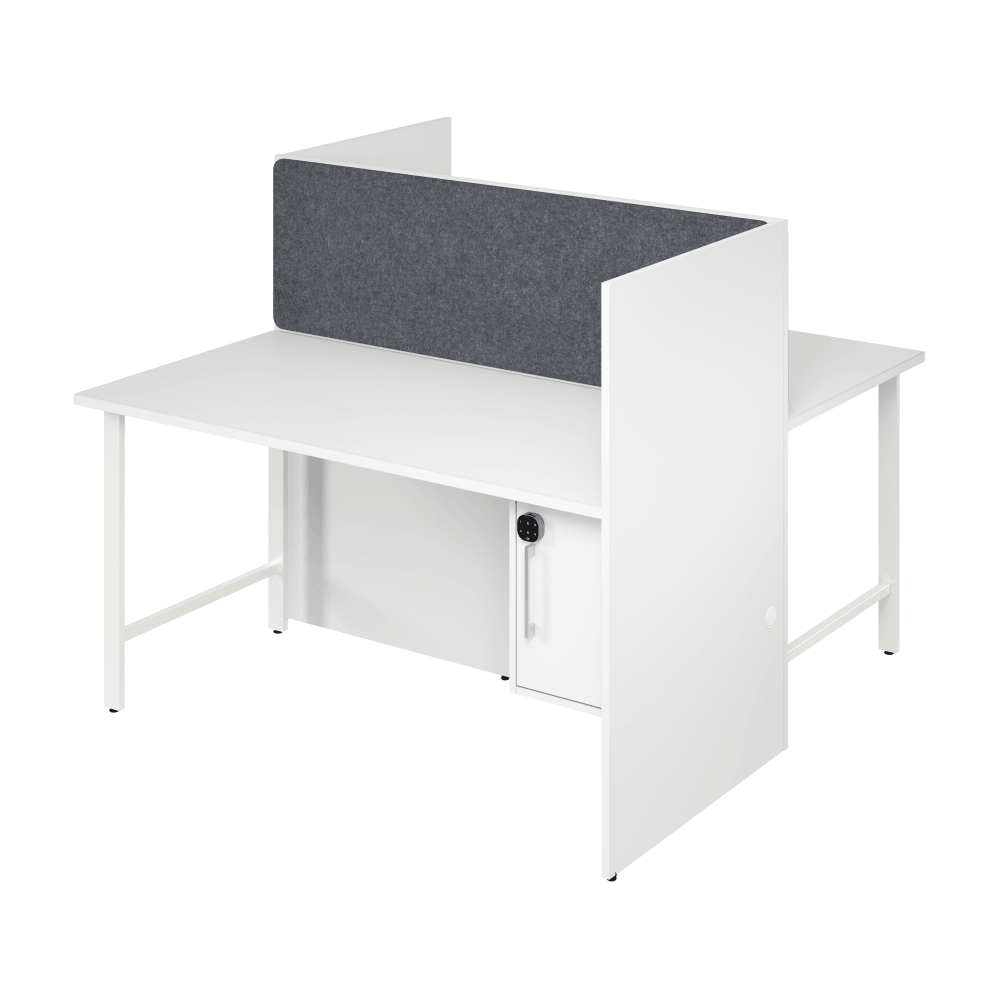
10. PET Color and Surface Customization
One of the main advantages of PET acoustic felt is its design flexibility.
Depending on the supplier, buyers may be able to specify:
- Standard felt colors
- Custom colors
- Two-tone designs
- CNC patterns
- Cut-out graphics
- Company logos
- Geometric designs
- Printed or laminated surfaces
- Fabric or decorative finishes
For office furniture manufacturers and distributors, it is useful to separate:
standard-stock colors
from
custom-production colors.
This makes it easier to manage MOQ, lead time, and replacement orders.
For international projects, ask the supplier to confirm the same color reference before mass production. For repeat orders, keeping a physical approved color sample is often more reliable than relying only on digital images.
11. Packaging and Shipping Matter More Than Many Buyers Expect
Office dividers are relatively large compared with their weight.
That means packaging efficiency directly affects international logistics costs.
A good B2B packaging plan should consider:
Panel protection
- Corner protection
- Surface protection
- Scratch prevention
- Moisture protection where appropriate
Hardware protection
Small fittings should not be loose inside the carton.
A complete hardware kit should be separately packed and clearly identified.
Carton dimensions
Large but lightweight products can consume substantial container volume.
For export projects, compare:
Units per carton
Carton dimensions
Gross weight
Cartons per pallet
Pallet dimensions
Units per container
This gives procurement teams a much more accurate landed-cost calculation.
12. What Should You Ask an Acoustic Desk Divider Manufacturer?
Before placing a bulk order, request the following documents and information:
Product documentation
- Product datasheet
- Dimensions and tolerances
- Material specification
- Density, where relevant
- Available thicknesses
- Available colors
Acoustic documentation
- NRC or equivalent acoustic rating
- Sound absorption coefficient data
- Test standard
- Test report
- Mounting configuration
Fire documentation
- ASTM E84 report for applicable North American projects
- EN 13501-1 classification/test documentation for applicable European projects
- Product construction covered by the report
Commercial information
- MOQ
- Sample policy
- Production lead time
- Packaging specification
- Container loading quantity
- Warranty terms
- Replacement policy
- OEM/ODM capabilities
A supplier that can provide this information quickly is generally easier to qualify for commercial projects.
13. Free Standing Desk Dividers vs. Full-Height Acoustic Partitions
It is also important to choose the right solution.
A free standing desk divider is usually appropriate when the main objectives are:
- Workstation separation
- Local acoustic absorption
- Visual privacy
- Flexible zoning
- Employee comfort
A full-height acoustic partition is more appropriate when the objective is:
- Higher speech privacy
- Stronger physical separation
- Room-to-room isolation
- Meeting room separation
- Permanent space division
For an open office, these solutions can also be combined.
For example:
Desk dividers + ceiling baffles + wall-mounted PET panels
can create a more comprehensive acoustic treatment strategy than using desk screens alone.

14. A Practical Buying Checklist for Distributors and Project Buyers
Before confirming a bulk purchase, check these ten points:
1. Application
Is the divider free standing, desk mounted, mobile, or fixed?
2. Dimensions
Are the width and height appropriate for the workstation system?
3. Material
What PET or polyester construction is being used?
4. Acoustic performance
Is there laboratory test data rather than only a marketing claim?
5. Fire performance
Does the tested configuration meet the target market’s requirements?
6. Hardware
Are the feet, brackets, clamps, and connectors included?
7. Stability
Has the complete assembly been evaluated, not just the PET panel?
8. Color
Are standard and custom colors clearly defined?
9. Logistics
How many panels fit per carton, pallet, and container?
10. Repeat orders
Can the supplier maintain consistent dimensions, color, and hardware specifications?
Conclusion: How to Choose the Right Office Desk Divider
The best office desk divider is not simply the panel with the highest NRC or the lowest price.
For commercial projects, buyers should evaluate the complete system:
Panel + acoustic performance + fire performance + dimensions + hardware + installation + packaging + supply capability
PET acoustic panels are especially suitable for modern offices because they can combine sound absorption, lightweight construction, flexible design, and modular installation.
For distributors, office furniture manufacturers, and commercial fit-out contractors, the most important step is to define the specification before requesting a quotation.
A professional RFQ should clearly state:
Panel size, thickness, material, color, acoustic requirement, fire requirement, mounting system, quantity, packaging, and delivery requirements.
Once these specifications are clear, suppliers can provide comparable quotations and the purchasing team can evaluate products on more than price alone.
For large-volume projects, working directly with an experienced acoustic panel manufacturer can also make it easier to coordinate custom colors, CNC designs, mounting hardware, packaging, certification documents, and repeat production.
Looking for PET acoustic desk dividers for an office project or wholesale order? Request the product specification, acoustic test data, fire documentation, available colors, and bulk quotation before making your final supplier decision.