

PET acoustic panels have become one of the most widely used acoustic materials in modern interior design. They appear in offices, conference rooms, schools, hotels, restaurants, studios, commercial spaces, and furniture systems.
But as the market has grown, so has the amount of conflicting information about PET felt acoustic panels.
How thick should a panel be? Does higher density always mean better acoustic performance? Can a 9mm or 10mm panel really absorb low-frequency sound effectively? Does NRC tell the whole story? Can PET felt be CNC cut or thermoformed? Are recycled PET panels actually recyclable? How should color consistency be controlled between batches?
These are not just theoretical questions. They directly affect product selection, project performance, installation, and long-term sourcing.
A recent discussion among acoustics professionals and PET felt users covered many of these exact issues, including thickness, density, acoustic performance, cutting, thermoforming, fire performance, color consistency, installation, and sustainability.
At Leedings Acoustic, we believe the best way to evaluate a PET acoustic panel is to look beyond marketing claims and understand how the material actually works.

What Are PET Acoustic Panels?
PET acoustic panels are porous sound-absorbing products made primarily from polyester fibers. Many products use recycled PET as part of the raw material stream.
Unlike hard reflective materials such as glass, concrete, or MDF, porous PET felt allows sound energy to enter the fibrous structure. Friction and viscous losses within the material convert part of the acoustic energy into heat.
This makes PET felt particularly useful for controlling:
- Reverberation
- Speech reflections
- Mid-frequency office noise
- High-frequency reflections
- General room echo
However, PET acoustic panels should not automatically be described as soundproofing products.
They primarily provide sound absorption, not the same type of sound isolation provided by massive walls, floating floors, resilient assemblies, or other sound-transmission-control systems.
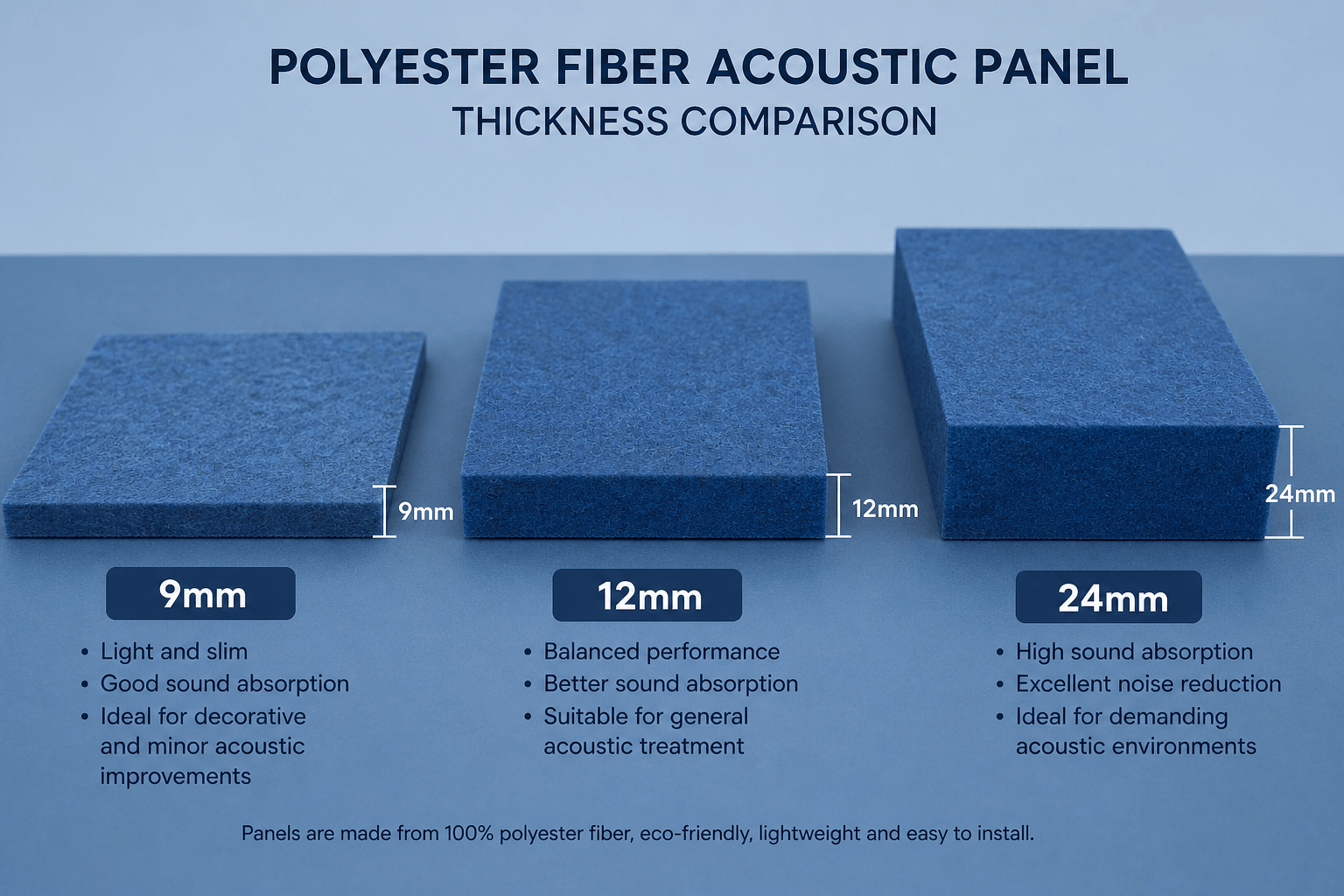
Thickness Matters — But Thickness Alone Does Not Determine Performance
One of the most important questions when specifying PET acoustic panels is thickness.
Common commercial thicknesses include:
- 9mm
- 12mm
- 18mm
- 24mm
In general, increasing thickness gives sound waves a greater depth of porous material to interact with and can improve absorption, particularly toward lower frequencies.
However, thickness is only one variable.
Acoustic performance is also influenced by:
- Material density
- Fiber structure
- Airflow resistivity
- Panel porosity
- Mounting method
- Air gap
- Total coverage
- Room geometry
This is one of the key issues raised discussion. One commenter questioned whether a very thin panel could realistically deliver a high absorption coefficient at 500 Hz. The mounting conditions matter substantially—for example, a relatively thin PET panel installed with a significant air gap can perform very differently from the same panel mounted directly to a wall.
That is an important distinction for buyers:
Never evaluate a PET acoustic panel based on thickness alone.
Why Air Gaps Can Make a Major Difference
A PET acoustic panel mounted directly against a hard wall behaves differently from the same panel installed with an air cavity behind it.
When an air gap is introduced, the effective absorption system becomes deeper.
Depending on the panel properties and mounting configuration, an air gap can improve absorption at lower frequencies.
For example, a project specification might compare:
- 12mm PET panel, direct mount
- 12mm PET panel + 50mm air gap
- 24mm PET panel, direct mount
These are not acoustically equivalent systems.
The actual absorption coefficient should therefore be evaluated using the tested installation condition, not simply the thickness of the material.
This is why professional acoustic testing normally reports the test configuration together with the results.
Does Higher Density Always Mean Better Acoustic Performance?
No.
This is another area where PET panel marketing can oversimplify the issue.
A PET acoustic panel needs an appropriate combination of:
fiber structure + thickness + density + airflow resistivity + mounting configuration
Increasing density indefinitely does not automatically produce better absorption across every frequency.
In fact, acoustic absorbers need an appropriate balance between allowing sound to enter the material and dissipating energy within the structure.
The discussion explicitly raised porosity and flow resistivity, which are much more technically informative than simply quoting material weight.
For professional acoustic applications, buyers should therefore ask suppliers:
What is the panel density or mass per unit area?
and, where relevant:
What acoustic test data or material parameters support the claimed performance?
Why NRC Is Important — But Not Enough
The Noise Reduction Coefficient (NRC) is commonly used to summarize sound absorption performance.
However, NRC is a single-number rating derived from absorption measurements at selected frequencies. It should not be treated as a complete description of acoustic performance.
For example, two panels could have similar NRC values but behave differently at:
- 125 Hz
- 250 Hz
- 500 Hz
- 1000 Hz
- 2000 Hz
- 4000 Hz
For acoustic consultants and engineers, the frequency-by-frequency absorption coefficients are often more useful than NRC alone.
Therefore, when evaluating a PET acoustic panel supplier, ask for the complete acoustic test data rather than only a headline NRC value.
PET Panels Are Not a Universal Low-Frequency Solution
This distinction is especially important.
PET felt is a lightweight, porous absorber. Its strongest applications are generally associated with controlling reflected sound and reverberation rather than providing heavy low-frequency isolation.
The discussion correctly highlighted that lightweight porous absorbers should not be regarded as an all-purpose solution for very low-frequency room modes. The manufacturer in the discussion also clarified that PET felt is primarily a mid- to high-frequency velocity absorber, while additional depth, air gaps, or hybrid constructions can extend useful performance toward lower frequencies.
Therefore, if a project has a major problem around very low frequencies, simply adding more thin PET panels may not be the most efficient solution.
A proper acoustic design may require:
- Thicker absorbers
- Larger air cavities
- Bass traps
- Membrane absorbers
- Hybrid acoustic systems
This is why room acoustics should be considered as a system rather than a single product specification.

How Are PET Acoustic Panels Cut?
One of the major advantages of PET felt is fabrication flexibility.
Depending on thickness, equipment, and product construction, PET panels can be processed using:
- Utility knives
- CNC drag knives
- CNC routers
- Waterjet cutting
- Other precision fabrication systems
Specifically discussed manual cutting, CNC cutting, drag-knife systems, V-grooving, and custom fabrication.
For small DIY applications, thin PET felt can often be cut manually.
For commercial projects, CNC fabrication provides better:
- Dimensional accuracy
- Repeatability
- Complex geometric patterns
- Logo cutting
- Large-volume production
This flexibility is one of the reasons PET acoustic panels have become so attractive to interior designers.
Can PET Acoustic Panels Be V-Grooved and Folded?
Yes.
V-grooving allows a sheet of PET felt to be partially cut so that it can fold into:
- Corners
- Three-dimensional forms
- Geometric acoustic structures
- Custom furniture components
The discussion specifically covered V-grooving and folding methods for PET felt.
For manufacturers, this creates an opportunity to produce acoustic elements that are not limited to flat rectangular panels.
Can PET Felt Be Thermoformed?
Yes.
PET is a thermoplastic material, which means that controlled heat can soften the material and allow it to be formed using tooling.
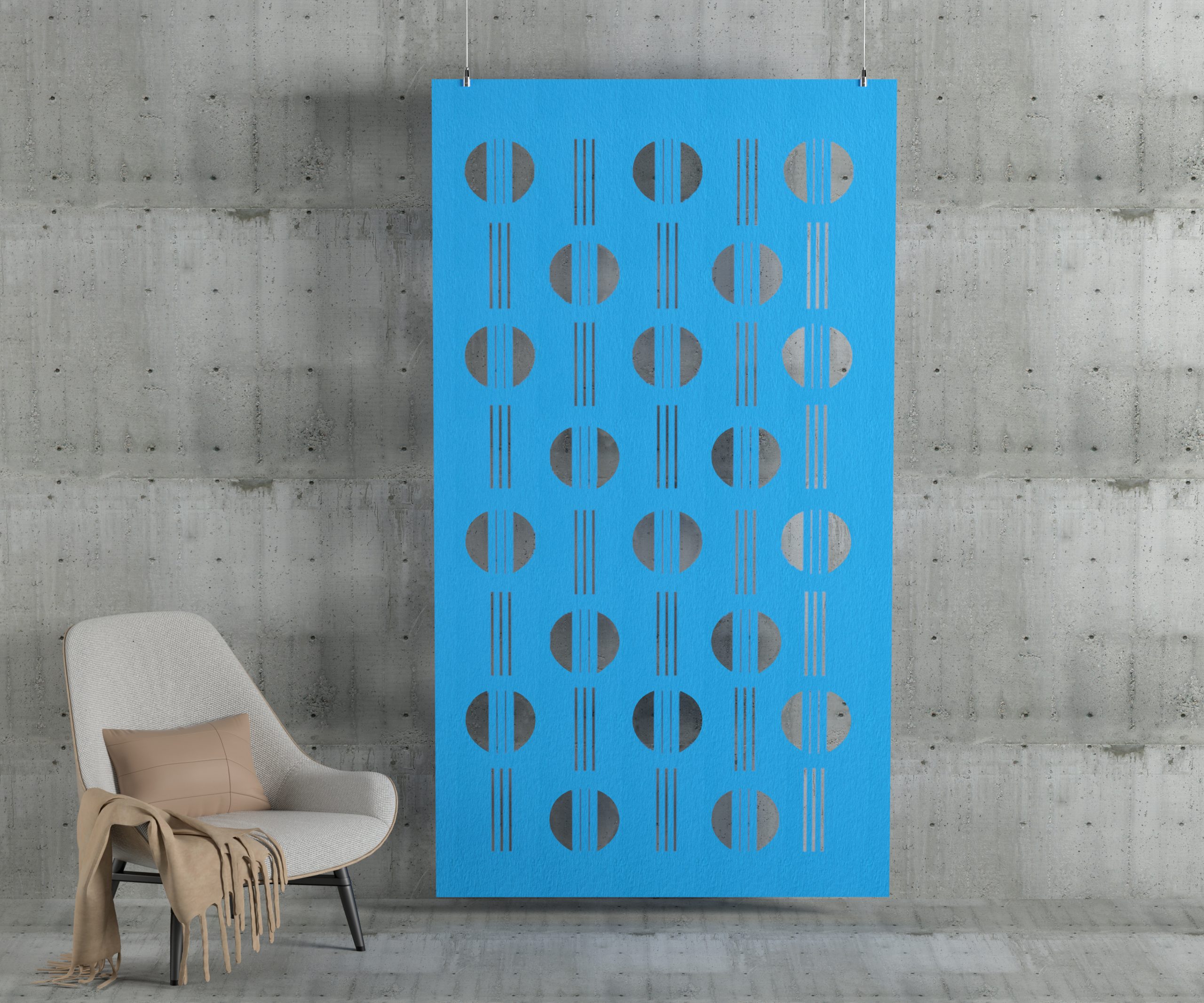
Thermoforming can be used to create:
- Curved acoustic panels
- 3D wall features
- Ceiling elements
- Sculptural acoustic objects
- Custom furniture components
The discussion described thermoforming as a process in which PET is heated, softened, and then pressed into a mold.
However, thermoforming must be controlled carefully.
Excessive heat or compression can change the local material structure and potentially affect acoustic properties.
Therefore, 3D design should be validated through product testing rather than assuming that a formed panel will perform identically to a flat panel.
What About Color Consistency?
Color is an increasingly important issue for commercial PET acoustic panels.
PET felt is often manufactured using colored polyester fibers rather than simply painting the finished surface.
The final color can be affected by:
- Raw material consistency
- Recycled PET feedstock
- Masterbatch formulation
- Fiber blending
- Thermal processing
- Production parameters
This means that long-term distributors should not simply specify a color name such as “dark grey.”
For consistent supply, it is better to maintain:
- A fixed color code
- A controlled formulation
- Standardized raw materials
- Production records
- Instrument-based color inspection
For large projects, batch-to-batch color tolerance should also be discussed before purchase.
Can Recycled PET Acoustic Panels Perform as Well as Virgin PET?
They can, provided the recycled material is properly controlled and the panel is engineered and manufactured consistently.
The acoustic performance of the finished panel is determined by its physical structure—not simply by whether the PET originated from recycled or virgin feedstock.
However, recycled raw materials introduce another layer of manufacturing variability.
This makes raw material quality control particularly important.
A reliable PET acoustic panels manufacturer should have procedures for:
- Recycled material sourcing
- Fiber quality control
- Material blending
- Density control
- Color consistency
- Production traceability
Sustainability should therefore be evaluated together with performance and manufacturing quality.
Is PET Acoustic Felt Actually Recyclable?
Potentially, yes—but there is an important distinction between:
“The material is recyclable”
and
“This installed product can realistically be recycled.”
The discussion raised exactly this concern. Adhesives, laminations, mixed materials, and permanent installation systems can make recovery and recycling more difficult.
For this reason, sustainability claims should be evaluated across the whole product lifecycle:
- Raw material
- Manufacturing
- Installation
- Service life
- Removal
- End-of-life processing
For example, a mechanically fixed PET panel may be easier to remove and potentially reuse than a panel permanently bonded to a substrate.
This is increasingly relevant to architects and commercial buyers working toward circular-design objectives.
What Should Importers Check Before Buying PET Panels?
For importers and distributors, product evaluation should go well beyond a price list.
A professional supplier should be able to provide clear information about:
Acoustic Performance
- Thickness
- Density or mass per unit area
- Acoustic test results
- Test standard
- Mounting condition
- Frequency-band absorption data
Fire Safety
- Applicable fire standard
- Fire classification
- Laboratory test report
- Tested product specification
Sustainability
- Recycled content
- Material composition
- Relevant environmental documentation
- Manufacturing information
Manufacturing
- Standard sizes
- Custom sizes
- Color options
- CNC fabrication
- Thermoforming capability
- OEM/ODM support
Quality Control
- Thickness tolerance
- Density consistency
- Color consistency
- Batch traceability
These questions help distinguish an actual PET acoustic panel manufacturer from a trading company that simply resells generic sheets.
What Designers Should Avoid When Specifying PET Acoustic Panels
Several common mistakes can lead to disappointing results.
Mistake 1: Choosing the Panel by NRC Alone
NRC does not describe the entire frequency response.
Mistake 2: Assuming Thicker Always Means Better
Thickness matters, but density, airflow resistance, and mounting configuration matter too.
Mistake 3: Expecting a Thin PET Panel to Solve Bass Problems
Low-frequency room modes generally require a different acoustic strategy.
Mistake 4: Ignoring the Air Gap
Mounting configuration can significantly change acoustic behavior.
Mistake 5: Treating “Recyclable” as the Same as “Circular”
Installation method and end-of-life processing also matter.
Mistake 6: Choosing a Supplier Without Test Documentation
A good-looking product image is not a substitute for acoustic, fire, and material data.
Why Choose Leedings Acoustic?
At Leedings Acoustic, we approach PET acoustic panels as both an acoustic material and an architectural material.
Our capabilities include:
- PET acoustic panels
- Polyester fiber acoustic panels
- Acoustic wall panels
- Office acoustic screens
- Ceiling acoustic solutions
- CNC-cut PET products
- Custom shapes and patterns
- OEM and ODM manufacturing
We work with distributors, furniture manufacturers, contractors, architects, and other B2B customers who need consistent manufacturing rather than simply a one-time shipment.
For project-specific applications, we can discuss:
- Thickness
- Density
- Color
- Dimensions
- Cutting requirements
- Installation method
- Acoustic requirements
- Fire performance
- Custom fabrication
Our goal is to help customers select the right PET acoustic panel construction for the actual application, rather than treating one panel specification as suitable for every project.

Final Thoughts: What Really Matters in PET Acoustic Panels?
The PET acoustic panel market has moved beyond simply asking:
“Is this a recycled polyester panel?”
The more useful questions are:
How does it perform?
Under what installation conditions?
What are the material properties?
How consistent is the manufacturing?
Can it be customized?
What documentation supports the claims?
The discussion is valuable precisely because it moves the conversation toward these technical questions—thickness, density, airflow resistivity, installation, fabrication, fire performance, color, and recyclability—rather than treating PET felt as a generic decorative material.
For designers and importers, the key lesson is simple:
Do not buy PET acoustic panels based on appearance or a single NRC number. Evaluate the material, the acoustic test conditions, the installation system, the manufacturing consistency, and the documentation together.
That is the approach Leedings Acoustic takes when developing and supplying PET acoustic solutions for international projects.