

For distributors, importers, architects, and project contractors, one of the most important quality concerns when sourcing PET acoustic panels is color consistency.
This is especially critical for long-term distribution programs, where customers expect the same color to remain stable across multiple shipments over several years.
A common question from buyers is:
“How much does the color vary from batch to batch, and how do manufacturers control it?”
The answer depends on raw materials, production technology, color management systems, and quality control procedures.
In this article, Leedings Acoustic, a professional acoustic panels supplier and manufacturer of PET acoustic panels in China, explains the industry’s best practices for controlling color variation.
Why Color Differences Occur in PET Acoustic Panels
Unlike painted surfaces, PET acoustic panels are manufactured from polyester fibers that are colored before panel formation.
Most environmentally friendly acoustic wall panels use recycled PET sourced from:
- Beverage bottles
- Mineral water bottles
- Food-grade PET packaging
- Industrial recycled polyester
Because the recycled material itself may vary slightly in color, achieving perfect color consistency is more challenging than with virgin materials.
Several factors contribute to batch-to-batch color variation.
1. Variation in Recycled PET Raw Materials
The largest source of color variation originates from the recycled PET feedstock.
Different batches of recycled bottles may contain:
- Different transparency levels
- Different residual color tones
- Different impurity contents
Even after purification, slight variations can remain.
This is why most PET manufacturers specify acceptable color tolerances rather than promising absolute color matching.


2. Masterbatch Pigment Variation
Color is typically achieved by adding color masterbatch during fiber production.
Factors affecting color include:
- Masterbatch supplier consistency
- Pigment concentration accuracy
- Dispersion quality
Leading manufacturers usually lock specific masterbatch suppliers and formulas to minimize variation.
3. Thermal Processing Conditions
PET acoustic panels are manufactured through high-temperature thermal bonding.
Production temperatures can exceed:
180°C–220°C (356°F–428°F)
Even small fluctuations in:
- Temperature
- Heating duration
- Cooling rate
can affect the final color appearance.
Darker colors are particularly sensitive to processing conditions.
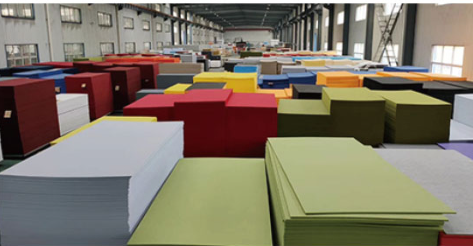
4. Fiber Mixing Uniformity
One of the most overlooked factors is fiber blending.
If colored fibers are not evenly mixed before forming the panel, the result may be:
- Visible color streaks
- Shade inconsistencies
- Localized color patches
Modern production lines use automated multi-bin blending systems to ensure homogeneous fiber distribution.
How the Industry Measures Color Difference
Professional manufacturers do not rely on visual inspection alone.
Instead, they use spectrophotometers and colorimeters to quantify color variation.
The international standard is:
Delta E (ΔE)
Delta E measures the difference between two colors.
Typical industry interpretation:
| ΔE Value | Visual Perception |
|---|---|
| ΔE ≤ 1.0 | Difference generally invisible to the human eye |
| ΔE 1.0–2.0 | Slight difference visible only under close inspection |
| ΔE 2.0–3.0 | Acceptable for most architectural applications |
| ΔE > 3.0 | Easily noticeable in side-by-side comparison |
For premium acoustic wall panels, manufacturers typically target:
ΔE ≤ 2.0–3.0
This is considered excellent consistency within the PET acoustic panel industry.

Industry Best Practices for Color Consistency Control
1. Fixed Masterbatch Suppliers
Professional manufacturers avoid changing pigment suppliers frequently.
Benefits include:
- Stable pigment chemistry
- Consistent color formulation
- Reduced batch variation
Many leading factories maintain long-term partnerships with selected masterbatch producers.
2. Raw Material Source Control
High-quality manufacturers often:
- Use fixed recycled PET suppliers
- Establish incoming material inspection procedures
- Control recycled-to-virgin PET ratios
This helps stabilize the base color before production begins.
3. Formula Locking
For long-term distributors, manufacturers often implement:
Color Formula Locking
This means:
- The same pigment recipe is maintained
- The same process parameters are recorded
- Future production follows identical specifications
This is particularly important for distributors building their own product brands.
4. Multi-Bin Automatic Fiber Blending
Advanced factories use:
- Multi-silo storage systems
- Automated fiber blending equipment
- Multiple-stage mixing processes
The goal is to achieve complete fiber homogeneity before panel formation.
This is one of the most effective methods for reducing color inconsistency.
5. Production Parameter Standardization
Leading manufacturers record:
- Heating temperatures
- Oven profiles
- Line speeds
- Cooling conditions
Every color may have its own optimized processing recipe.
At Leedings Acoustic, production parameters are documented and standardized to ensure repeatability across future orders.
6. Spectrophotometer-Based Quality Inspection
Modern color control requires objective measurement.
Typical quality procedures include:
- Incoming material testing
- In-process color checks
- Final batch approval using colorimeters
This eliminates subjective visual judgment.
Special Strategy for Long-Term Distributors
For customers establishing distribution programs in markets such as Mexico, the United States, Europe, or Canada, many manufacturers adopt an additional strategy:
Reserved Raw Material Inventory
Instead of purchasing materials separately for every order, manufacturers may:
- Reserve large quantities of the same fiber batch
- Maintain dedicated inventory for specific colors
- Produce multiple future orders from the same raw material lot
This significantly improves long-term color consistency.
Popular colors such as:
- Light Grey
- Dark Grey
- Black
- Beige
are often managed this way for distribution customers.
What Color Tolerance Can Buyers Realistically Expect?
For recycled PET acoustic panels, absolute zero color difference is not technically realistic.
However, with professional manufacturing controls, buyers can generally expect:
- Stable visual appearance across production batches
- ΔE values within industry standards
- Consistency suitable for commercial and architectural projects
High-quality manufacturers typically maintain color variation within a range that is not noticeable in normal installation environments.
How Leedings Acoustic Controls PET Panel Color Consistency
As a professional acoustic panels supplier in China, Leedings Acoustic implements multiple layers of color control:
- Fixed raw material sourcing channels
- Stable masterbatch supply partnerships
- Formula locking for repeat orders
- Automated fiber blending systems
- Process parameter standardization
- Instrument-based color inspection
For long-term distributors, we also support dedicated color management programs to improve consistency across future production runs.
Conclusion
Color consistency is one of the most important quality indicators for PET acoustic panels.
While minor variation is inevitable due to the use of recycled materials and thermal processing, professional manufacturers control these variations through:
- Delta E color management
- Raw material standardization
- Masterbatch control
- Automated blending systems
- Instrument-based quality inspection
For distributors seeking a long-term supply partner, understanding these industry practices is essential when evaluating potential suppliers of acoustic wall panels and PET acoustic panels.
By working with an experienced manufacturer such as Leedings Acoustic, buyers can achieve reliable color consistency while benefiting from the sustainability advantages of recycled PET materials.