

Akupanels—also known as wood slat acoustic panels with PET felt backing—are designed for long-term architectural use. However, many customers, designers, and contractors ask an important question before installation:
Can Akupanels be removed and reinstalled?
The short answer is yes, but the success of removal and reinstallation depends largely on the original installation method, wall condition, and handling process. In this article, Leedings explains when Akupanels can be reused, how to remove them safely, and what to expect during reinstallation.
What Determines Whether Akupanels Can Be Reinstalled?
Several factors affect removability:
Installation method (adhesive vs screws)
Wall substrate (drywall, concrete, brick)
Panel size and thickness
Care taken during removal
Understanding these factors helps prevent damage to both the panels and the wall.

Removing Akupanels Installed with Screws
Best Option for Reinstallation
Akupanels fixed with screws are the easiest to remove and reinstall.
Removal Process
Locate screw positions (usually through the PET felt backing)
Unscrew carefully using a screwdriver or drill
Gently pull the panel away from the wall
Store panels flat to prevent warping
Reinstallation
Panels can usually be reinstalled with minimal effort
Existing screw holes in the felt do not affect acoustic performance
Ideal for offices, rented spaces, and exhibition projects
Professional tip: Screw installation is recommended if future removal is expected.
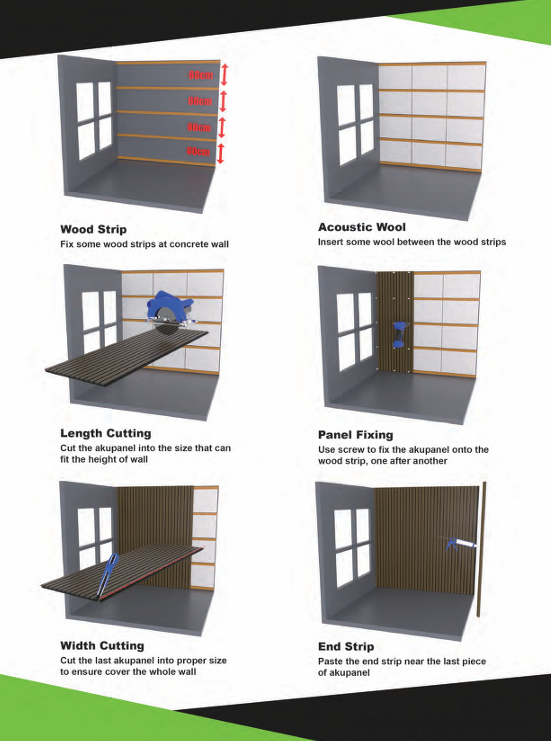
Removing Akupanels Installed with Adhesive
Possible, but More Challenging
Adhesive-mounted Akupanels can be removed, but risks increase.
What to Expect
Adhesive may damage drywall surfaces
PET felt backing can tear if force is applied unevenly
Some adhesive residue will remain on the panel or wall
Safe Removal Tips
Use a wide, flat pry tool
Apply slow, even pressure from multiple points
Avoid pulling from slats directly
Cut adhesive with a thin blade if accessible
In many cases, adhesive-mounted panels can be partially reused, but cosmetic or felt damage may occur.
Wall Surface Considerations
| Wall Type | Reinstall-Friendly | Notes |
|---|---|---|
| Drywall | Moderate | Wall repair often required |
| Concrete | High | Minimal surface damage |
| Brick | High | Screw holes easily reused |
Concrete and brick walls generally allow cleaner removal and reinstallation compared to drywall.
Can Akupanels Be Reinstalled in a New Location?
Yes—if:
Panels are removed intact
Slats and felt remain structurally sound
Minor cosmetic marks are acceptable or hidden
Akupanels are frequently reused in:
Office relocations
Showrooms and exhibitions
Temporary interior installations
Does Removal Affect Acoustic Performance?
No—acoustic performance is not affected by removal or reinstallation as long as:
PET felt backing remains intact
Slat spacing is not altered
Panels are reinstalled with proper alignment
Small screw holes or surface marks do not impact sound absorption.
Best Practices for Reusable Akupanels
Choose screw mounting if future removal is likely
Avoid excessive adhesive coverage
Label panels during removal for easier reinstallation
Transport panels flat and protected
Why Leedings Akupanels Are Easy to Handle
Leedings Akupanels are engineered for:
Structural stability
Durable PET acoustic felt backing
Clean screw-through installation
Long-term reusability
This makes them suitable for both permanent and semi-permanent architectural applications.
Final Thoughts
So, can Akupanels be removed and reinstalled?
Yes—with the right installation method and careful handling, Akupanels can be reused without compromising their acoustic or visual performance.
If your project requires flexibility, relocation, or phased installation, the Leedings team can recommend the best fixing method from the start.